Can Filters Remove Microplastics From Water?
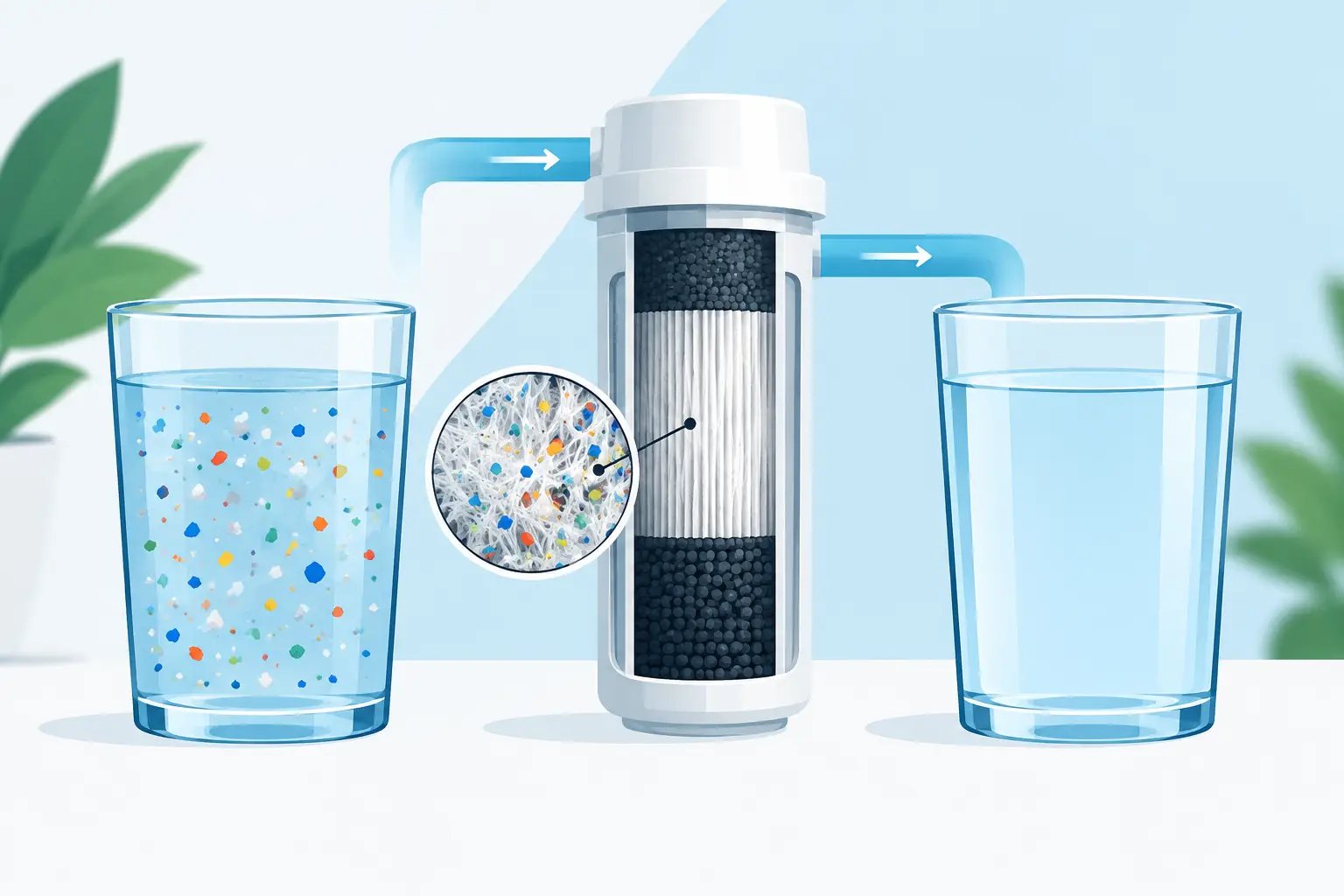
Microplastics are small enough to be easy to overlook, yet they have been detected in water, food, air and household environments. So, can filters remove microplastics from the water coming into your home? The answer is yes, but performance depends heavily on the filtration technology, the size of the particles and whether the system is properly maintained.
For Australian households seeking greater control over drinking-water quality, a well-designed reverse osmosis system is generally the strongest option for reducing very small particulate contaminants. Whole-home filtration can also play an important role by treating water used for showers, baths, laundry and cleaning.
What are microplastics?
Microplastics are plastic fragments generally smaller than five millimetres. They can come from the breakdown of larger plastic items, synthetic clothing fibres, tyre wear, personal-care products and industrial sources. The smallest particles are often described as nanoplastics, although definitions and testing methods are still developing.
Their size is the challenge. Some microplastics are visible as fibres or fragments, while others are far too small to see. A filter that captures larger sediment may reduce some particles but allow much smaller material to pass through. This is why the phrase “filtered water” on its own does not tell you how well a system may perform against microplastics.
Can filters remove microplastics at different sizes?
A filter works by creating a barrier, trapping contaminants within media, or using both approaches. The pore size, membrane design and water pressure all influence what it can remove. It is also worth remembering that laboratory results may not exactly match conditions in every home, where water quality and flow rates vary.
Sediment filters catch larger particles
Sediment filtration is often the first treatment stage in a household system. It is designed to capture visible grit, rust, sand and other suspended matter that may enter through mains water, rainwater supplies, ageing pipes or water tanks.
Fine sediment cartridges can reduce larger microplastic fragments and fibres. However, they are not a complete solution for the smallest particles. Their primary value is protecting the filtration stages that follow and improving the clarity of water throughout the home.
Carbon filtration improves taste and chemical reduction
Activated carbon is highly effective for addressing chlorine taste and odour, and can reduce a range of chemical contaminants depending on the filter media and system design. It is an essential part of many quality drinking-water and whole-house systems.
Carbon filters should not, however, be selected solely for microplastic removal. Carbon works mainly through adsorption rather than acting as a precision physical screen. It may capture some particulate matter when paired with sediment stages, but it is not the most reliable stand-alone technology for very small microplastics.
Reverse osmosis provides precision membrane filtration
Reverse osmosis, often called RO, uses a semi-permeable membrane engineered to separate water from a broad range of dissolved impurities and extremely fine contaminants. Because the membrane operates at a molecular level, it is widely regarded as one of the most effective residential treatment methods for reducing very small particulate material, including microplastics.
A quality reverse osmosis system typically combines several stages: sediment pre-filtration, activated carbon treatment, the RO membrane and often a final polishing filter. Together, these stages protect the membrane, improve water taste and support high-level contaminant reduction.
This matters because microplastics rarely occur alone. A household may also be concerned about fluoride, chlorine, heavy metals, PFAS/PFOA, dissolved solids or unpleasant odours. Reverse osmosis can address a much broader water-quality picture than a basic jug filter or a simple carbon cartridge.
Ultrafiltration can be useful, with limits
Ultrafiltration uses a membrane with larger pores than reverse osmosis. It can be effective for reducing suspended particles, sediment and some microorganisms, while retaining more naturally occurring minerals than RO.
For microplastics, ultrafiltration may provide meaningful reduction where particle sizes are within its rated range. Yet it does not offer the same molecular-level separation as reverse osmosis, particularly for the smallest particles and dissolved contaminants. The right choice depends on the water source, household priorities and the level of treatment required.
What a whole-home system can and cannot do
A whole-house water filtration system treats water at the point where it enters the residence. This allows your family to shower, bathe, wash clothes and clean with treated water rather than limiting filtration to one kitchen tap.
For households concerned about chlorine odour, sediment, hard-water minerals and general water comfort, whole-home treatment delivers practical benefits. Water can feel gentler on hair and skin, showers can smell cleaner, and bathroom surfaces may be easier to maintain where mineral treatment is included.
Microplastic reduction in a whole-home system depends on the specific filters installed. A system with appropriately rated particulate filtration can capture larger plastic fragments before water reaches household outlets. But a standard whole-house filter should not automatically be assumed to remove the smallest microplastics or dissolved contaminants.
A considered approach is often to combine whole-home filtration with a dedicated reverse osmosis drinking-water system. The whole-home system improves the quality of water used across the residence, while RO provides precision membrane filtration at the drinking-water point where the highest level of treatment is wanted.
UV-C treatment has a different job
Advanced UV-C technology is valuable for controlling biological contaminants such as bacteria and other microorganisms, especially for homes using rainwater, bore water or other private supplies. UV-C exposes water to ultraviolet light that disrupts the ability of microorganisms to reproduce.
It does not physically remove microplastics. UV-C should be viewed as an additional protection stage within a carefully engineered system, not as a substitute for sediment filtration or reverse osmosis. Clear water is also important, as excessive sediment can interfere with UV performance.
How to choose a filter for microplastic concerns
The most useful question is not simply whether a filter removes microplastics. Ask what it has been designed to reduce, at what flow rate, and under which operating conditions. A reputable supplier should be able to explain the role of each filtration stage without making vague or unrealistic promises.
Look for a system that matches the water you use. Mains water, tank water, bore water and mixed supplies can require different treatment configurations. Water testing can identify concerns such as hardness, iron, sediment or biological risk that influence the right design.
For drinking water, consider reverse osmosis where you want a high standard of reduction for dissolved impurities and extremely fine contaminants. For all water outlets, consider whole-home pre-filtration and specialised treatment appropriate to your supply. If biological quality is a concern, add UV-C treatment after effective particulate filtration.
Maintenance is not optional. Sediment and carbon cartridges need replacement on schedule, while reverse osmosis membranes require periodic assessment and replacement. An overdue cartridge can reduce performance, restrict water flow and allow trapped material to build up inside the housing. Professional installation and ongoing servicing help ensure a system continues to perform as intended.
A practical path to cleaner household water
Research into the health effects of microplastics is continuing, and no single filter should be presented as a cure-all for every water concern. What homeowners can do is choose technology that provides a meaningful barrier against the contaminants they want to reduce.
Home Water Filtration can help assess your household water needs and design a treatment solution that combines whole-home comfort with precision filtered drinking water. When your system is engineered for your supply and maintained correctly, every glass, shower and tap becomes a more confident part of family life.


Comments