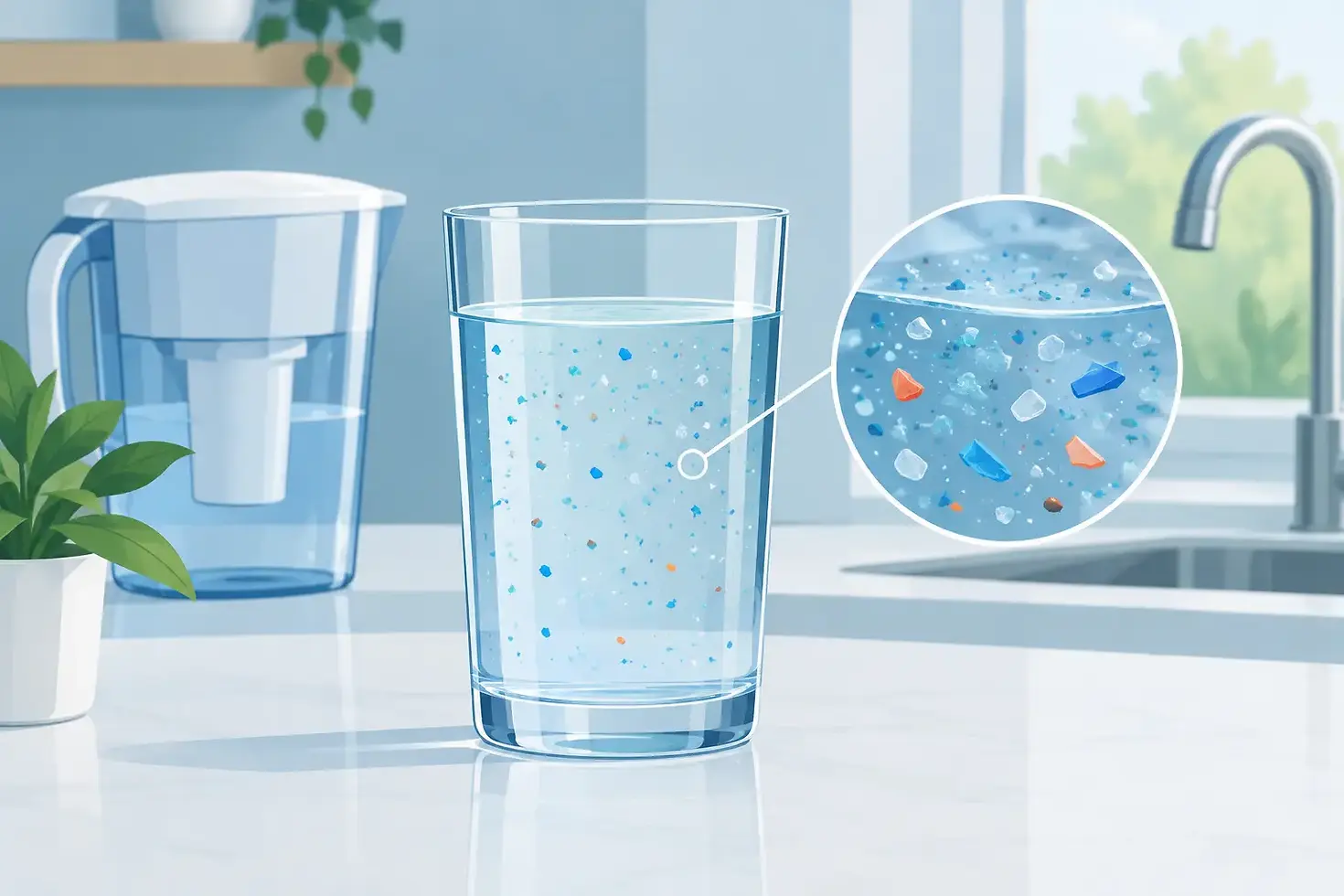
Microplastic Contamination in Household Water
A glass of tap water can look perfectly clear while still carrying particles too small to see. Microplastic contamination has become a growing concern for Australian households because plastics are now present across the environment - in rainfall, waterways, food packaging, synthetic fabrics and household plumbing materials. Clear water is not always the same as water treated for the broadest possible range of impurities.
For families who want greater control over their water quality, the practical question is not whether every trace of plastic can be eliminated. It is how to reduce exposure sensibly, using filtration engineered for the water entering and moving through their home.
What is microplastic contamination?
Microplastics are small pieces of plastic generally measuring less than five millimetres. They can be visible fragments, but many are far smaller - including particles measured in microns and, in some research, even smaller nanoplastic particles. Their size, shape and chemical makeup vary widely, which makes them difficult to measure consistently and even harder to remove with a single, basic filter.
They are created when larger plastic items break down through sunlight, friction and weathering. They can also originate as tiny manufactured particles or fibres. Synthetic clothing can shed fibres during washing, vehicle tyres release particles onto roads, and plastic packaging and containers may contribute particles as they age or are exposed to heat.
Microplastic contamination is not limited to one source or one type of water supply. It may enter waterways and reservoirs, move through wastewater systems, travel in rainwater, or arise from materials that water encounters on its way to the tap. Municipal treatment makes drinking water safe according to regulated standards, but treatment processes are not necessarily designed around every emerging contaminant or every particle size.
How microplastics can reach your tap
Water has a long journey before it fills a kitchen glass. Along the way, particles may be present in the source water, introduced through environmental runoff, or influenced by ageing pipes, fittings and storage systems. For households using rainwater tanks, bore water or other private supplies, local conditions and system maintenance can have an even greater effect on water quality.
That does not mean every home has the same level of exposure. Results depend on the water source, nearby land use, rainfall, plumbing condition and the testing method used. Research into microplastics is still evolving, and there is no single figure that describes all Australian homes.
This uncertainty is exactly why a layered water-treatment approach makes sense. Rather than relying on appearance, taste or odour alone, households can use professionally selected filtration stages to address sediment, dissolved impurities and potential biological contaminants in the places that matter most.
Can water filters reduce microplastic contamination?
Yes, but performance depends on the filter type, its pore size, water pressure, installation quality and maintenance. A simple jug filter may improve taste and reduce some chlorine-related compounds, yet it is not designed to provide comprehensive particle removal across every water outlet. It also cannot protect the water used for showering, bathing, laundry and cleaning.
A whole-house system commonly starts with sediment filtration. This stage captures larger suspended matter before it reaches appliances, taps and later treatment stages. It can help reduce grit, sediment and larger particles, while protecting finer filters from blocking prematurely. The precise micron rating should suit the household's incoming water quality rather than being selected on marketing claims alone.
For drinking water, reverse osmosis offers a more refined level of treatment. Precision membrane filtration pushes water through an exceptionally fine membrane, separating it from a wide range of dissolved impurities and very small particles. A properly designed reverse osmosis system can reduce up to 99% of dissolved impurities, depending on the water conditions and the specific system configuration.
Reverse osmosis is particularly valuable at the kitchen tap because this is the water your family drinks, cooks with and uses for tea, coffee and baby formula. It can also reduce fluoride, heavy metals, PFAS/PFOA and other dissolved contaminants that are not addressed by basic particle filters. Microplastics are only one reason to consider high-performance drinking-water treatment.
Why one filter is rarely the complete answer
Filtration is not a one-size-fits-all purchase. A coarse filter can stop larger particles but will not offer the same reduction of fine contaminants as an advanced membrane. Reverse osmosis delivers outstanding purity for drinking water, but it is usually installed at a point of use rather than treating every shower and bathroom tap. Whole-home filtration provides broad household coverage, while reverse osmosis provides molecular-level treatment where drinking-water quality is most critical.
Many homes benefit from combining both. Whole-house filtration can reduce sediment, chlorine odour and unwanted materials throughout the residence. A reverse osmosis system at the kitchen provides a dedicated source of highly treated drinking water. Where biological quality is a concern, advanced UV-C technology can be added to help manage microorganisms without relying on chemical dosing.
Choosing a system for your household water
Start with the water you actually have, not the filter someone happens to be selling. Town water, tank water, bore water and mixed supplies each create different treatment priorities. A household with heavily chlorinated mains water may focus on chlorine reduction and drinking-water purity. A property using tank water may also need sediment management, ultraviolet treatment and careful tank maintenance.
A useful assessment considers the source water, existing pipes, household size, peak water use and the specific outcomes you want. If your main concern is drinking water, a quality reverse osmosis system may be the first priority. If you want to shower, drink and bathe in filtered water, a whole-house system gives broader protection and everyday comfort.
Ask clear questions about what the system is designed to reduce, how it performs at your household flow rate and what replacement schedule it requires. Claims should be specific. No reputable provider should imply that one cartridge removes every contaminant under every condition, forever. Filters need scheduled servicing, membranes need monitoring, and UV-C lamps need replacement to keep delivering the intended treatment.
Maintenance protects filtration performance
A water filter is only as effective as its condition. Sediment cartridges gradually load with material, carbon media has a finite capacity, and reverse osmosis membranes can lose performance if pre-filtration is neglected. Delaying service may reduce water flow, affect taste and place unnecessary strain on the system.
Professional installation also matters. Correct sizing helps maintain suitable flow to showers and appliances, while properly positioned filtration protects equipment and makes ongoing servicing straightforward. This is especially important for whole-home solutions, where the system must support the demands of the entire residence without compromising practical water pressure.
Better water decisions begin with a broader view
Microplastic contamination is a valid reason to look more closely at household water, but it should not be treated in isolation. The same water may contain chlorine, mineral hardness, heavy metals, fluoride or other impurities that affect what your family drinks and how water feels throughout the home.
A well-designed treatment solution addresses the water source, the way your household uses water and the outcomes you value most. Home Water Filtration can help assess those needs and specify professional-grade filtration for cleaner drinking water and greater confidence at every tap.
The goal is not fear of the water coming into your home. It is the reassurance of knowing your family has a carefully engineered layer of protection between that supply and the water you use every day.


Comments