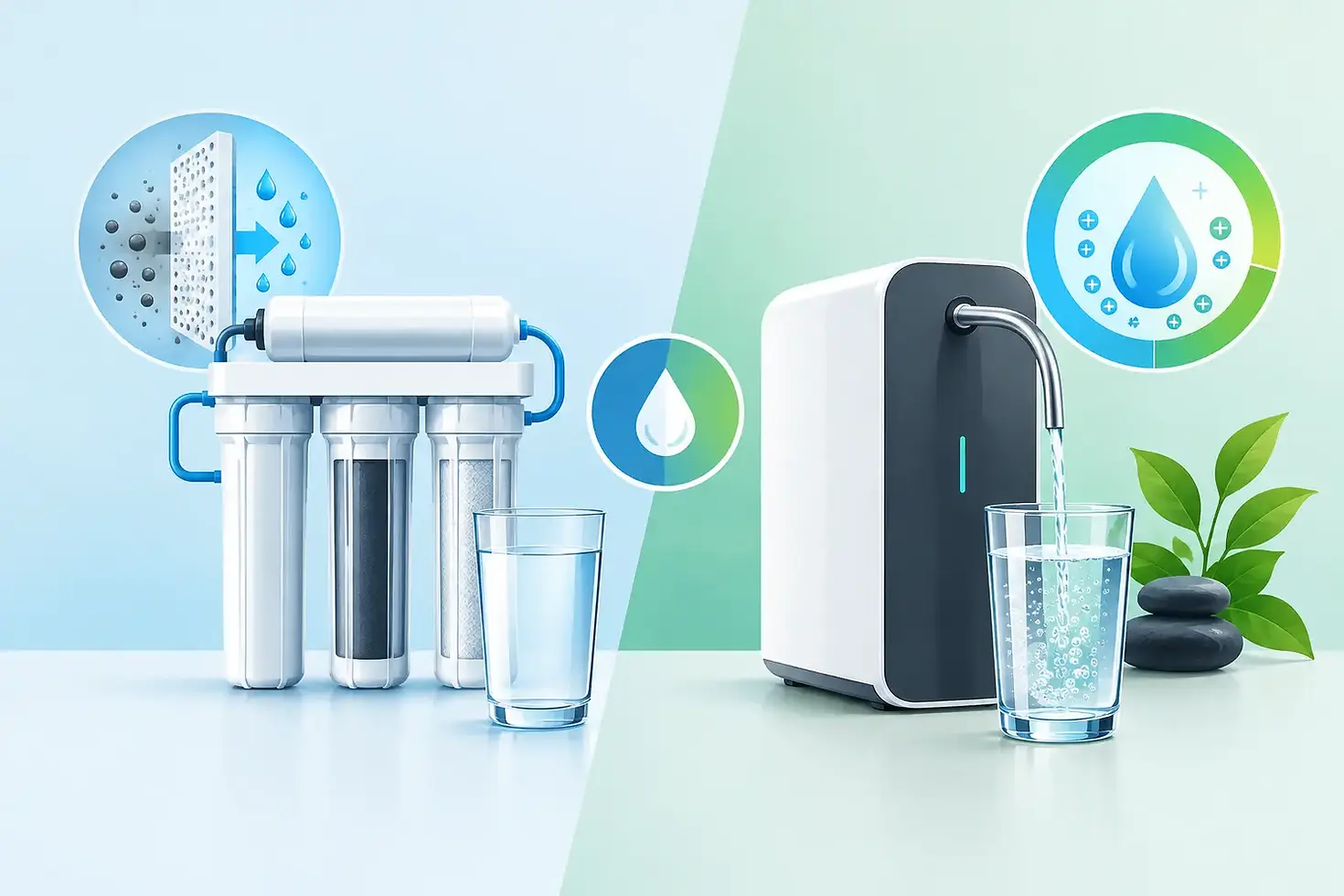
Reverse Osmosis Versus Alkaline Water Compared
A glass of water can look perfectly clear while carrying dissolved minerals, chlorine by-products, fluoride, trace metals or other substances you would rather reduce. That is why reverse osmosis versus alkaline water is not simply a debate about taste or pH. It is a decision about what your household wants its drinking water system to do: remove a broad range of dissolved impurities, add minerals, or achieve a considered balance of both.
For Australian families, the best answer depends on your incoming water quality, your location, your preferred taste and whether you are looking for a dedicated drinking-water solution or cleaner water throughout the home. Understanding the difference prevents one common mistake: choosing water based on an “alkaline” label while overlooking the treatment process behind it.
Reverse osmosis versus alkaline water: the key difference
Reverse osmosis is a purification process. Water is pushed through a precision membrane with extremely fine pores, separating water molecules from many dissolved contaminants. A professionally specified reverse osmosis system can reduce up to 99% of dissolved impurities, depending on the system, membrane condition and the contaminants present.
Alkaline water describes water with a pH above 7. It is not one specific filtration method. Water may be alkaline because it naturally contains minerals such as calcium and magnesium, because it has passed through an ionising device, or because minerals have been added after filtration.
In simple terms, reverse osmosis focuses on removal. Alkaline water focuses on pH and, in many cases, mineral content. Neither term alone tells you everything about the quality or safety of the water.
A water supply can be alkaline and still contain contaminants you wish to filter. Equally, reverse osmosis water can be exceptionally low in dissolved solids but have a lighter, cleaner taste that some people prefer and others find less familiar.
What reverse osmosis removes from drinking water
A reverse osmosis drinking-water system is engineered for purity at the point where your family fills a glass, kettle or cooking pot. With suitable pre-filtration and a correctly maintained membrane, it can substantially reduce a broad range of dissolved substances that ordinary carbon filters may not address to the same extent.
Depending on the water source and system design, this may include fluoride, heavy metals, salts, nitrates, many PFAS/PFOA compounds and other dissolved impurities. Carbon pre-filters are typically used to reduce chlorine and improve taste while protecting the membrane. Some systems also incorporate post-filtration for final taste conditioning.
This matters when your priority is confidence in what is being removed, rather than simply changing the water’s pH. Reverse osmosis provides a measurable, molecular-level treatment barrier. It is particularly useful where households want to reduce total dissolved solids or have specific concerns about contaminants in their supply.
There are trade-offs. Because the membrane also reduces naturally occurring calcium and magnesium, reverse osmosis water is low in mineral content. It also produces a separate concentrate stream as part of the filtration process. System selection, professional installation and regular filter changes matter if you want dependable performance over time.
What alkaline water can and cannot tell you
Alkaline water is often promoted as a healthier choice, but pH is only one water characteristic. A higher pH does not confirm that chlorine, fluoride, heavy metals, PFAS/PFOA, bacteria or other contaminants have been reduced. It also does not make a water source pure.
Many alkaline water systems work by electrically separating the water stream or by introducing alkaline minerals. If the system does not include effective filtration before alkalisation, the original dissolved impurities may remain in the water. This is why the treatment sequence is more meaningful than the label on the tap.
Claims that alkaline water can prevent or cure disease should be treated cautiously. Your body regulates its own blood pH tightly, and drinking water should not be viewed as a substitute for medical advice, a balanced diet or prescribed treatment. For most people, the practical appeal of alkaline water is its taste and the presence of added minerals, not a guaranteed health transformation.
Naturally mineral-rich water can taste pleasant, but it may also contribute to scale inside kettles, coffee machines and hot-water appliances. Whether that is desirable depends on the mineral levels and the needs of your household.
Does reverse osmosis water need to be alkaline?
Not necessarily. Clean, properly filtered reverse osmosis water is suitable for drinking without being deliberately alkalised. Its pH can sit near neutral, although it may vary after exposure to air because low-mineral water has little buffering capacity.
For households that prefer a more mineralised taste, remineralisation can be added after the reverse osmosis stage. A quality remineralisation cartridge reintroduces selected minerals in controlled amounts, often raising pH modestly while retaining the benefits of the membrane filtration process.
This approach is different from choosing an alkaline system first and assuming it provides comprehensive contaminant reduction. The order is what counts: purify the water through precision membrane filtration, then condition the final drinking water if you want minerals or a particular taste profile.
For families concerned with both purity and preference, reverse osmosis with post-filtration remineralisation can be a sensible middle ground. It should be selected according to the water test results and the system’s verified performance, rather than a broad promise about alkalinity.
Your drinking water is only part of the household picture
Reverse osmosis is highly effective for drinking and cooking water, but it is generally installed at a dedicated kitchen tap because treating an entire home through reverse osmosis would be impractical for most residences. Showering, bathing, washing clothes and cleaning are better addressed through a whole-home filtration strategy designed for household flow rates.
A whole-house system can reduce chlorine odour and sediment before water reaches the bathroom, laundry and kitchen. Depending on your water source and treatment requirements, specialised media can target hardness, iron or other local issues, while advanced UV-C technology can provide an additional biological treatment barrier where appropriate.
The everyday benefits are easy to recognise: less chlorine smell in the shower, water that feels gentler on hair and skin, and reduced residue on shower screens and fixtures where hardness treatment is included. Pairing whole-home filtration with a reverse osmosis drinking tap means your family receives treated water at every outlet, with molecular-level purification where it matters most for consumption.
How to choose the right option for your home
Start with the question behind the purchase. If you are mainly looking for a higher-pH water with a particular mineral taste, an alkaline or remineralisation stage may suit your preference. If your priority is reducing dissolved impurities, reverse osmosis is the stronger foundation.
Your incoming water should guide the specification. Mains water quality can differ across regions, while rainwater, bore water and tank water have entirely different treatment needs. A system designed for a suburban mains supply may not be appropriate for a property with sediment, microbial risks, high hardness or elevated dissolved solids.
Also consider how your household uses water. A family relying on bottled water for drinking may benefit most from an under-sink reverse osmosis system. A home that is sensitive to chlorine odour, has dry-feeling skin after showers or struggles with staining and scale may need broader treatment at the main water entry as well.
Maintenance deserves equal attention. Filters and membranes are not fit-and-forget components. Replacing them on schedule protects water quality, preserves flow and helps the system perform as designed. A professional consultation should explain not only what the equipment removes, but also the servicing required for your water conditions.
A clearer way to think about water quality
The question is not whether reverse osmosis or alkaline water is universally better. It is whether your system is designed to remove the substances you are concerned about, deliver water you enjoy drinking and support the way your household lives.
At Home Water Filtration, that often means considering the complete path of water through the residence: whole-home treatment for showering, bathing and cleaning, plus precision membrane filtration for drinking and cooking. If you enjoy a mineral taste, remineralisation can be considered after purification rather than in place of it.
The most reassuring choice is one based on your source water, your family’s priorities and a system engineered to perform at every tap that matters.


Comments